
──┬─ + ─────┬──────────────────────────────────────────────────────────┤
  ├─ - ─────┤
  ├─ * ─────┤
  ├─ TIMES ─┤
  ├─ MUX ───┤
  ├─ / ─────┤
  ├─ DIV ───┤
  ├─ MOD ───┤
  └─ ** ────┘
The operators +, –, *, and / have the conventional mathematical meaning of addition, subtraction, multiplication, and division, respectively. No two operators can be adjacent, and implied multiplication is not allowed.
The TIMES operator also denotes multiplication.
The DIV operator denotes integer division. It has the following mathematical meaning:
Y DIV Z = SIGN(Y/Z) * ENTIER(ABS(Y/Z))
The MOD operator denotes remainder or modulo division. If Z is greater than or equal to 1, MOD has the following meaning:
Y MOD Z = Y - (Z * (Y DIV Z))
If Z is less than 1, the MOD operator produces undefined results.
The MUX operator multiplies either single-precision or double-precision arithmetic primaries, and yields a double-precision result.
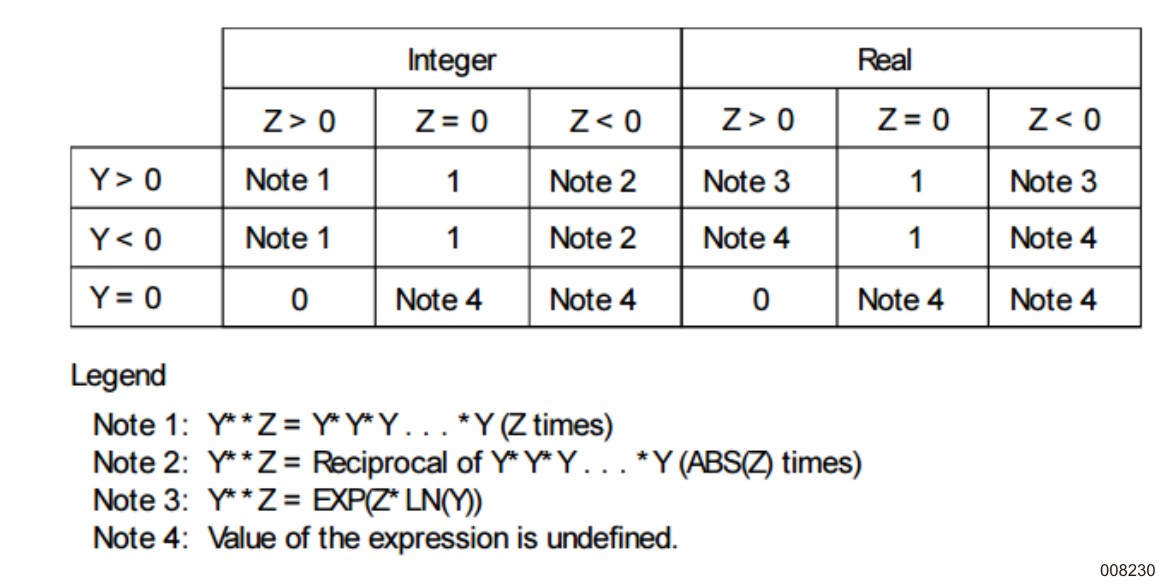
The ** operator denotes exponentiation. The semantics of the exponentiation operator depend on the types and values of the primaries involved. Exponentiation: Meaning of Y**Z explains the various meanings of Y**Z.
Precedence of Arithmetic Operators
The sequence in which the operations of an arithmetic expression are performed is determined by the precedence of the operators involved. The order of precedence is as follows:
-
** (highest precedence)
-
*, /, MOD, DIV, MUX, TIMES
-
+, -
Operators with the same precedence are applied in their order of appearance in an expression, from left to right.
The precedence of the assignment operator (:=) is as follows:
-
An expression to the right of an assignment operator is evaluated before the assignment.
-
The assignment is done before the evaluation of an expression involving the variable that is the target of the assignment.
Parentheses can be used in normal mathematical fashion to override the defined order of precedence. An expression in parentheses is evaluated by itself, and the resulting value is subsequently combined with the other elements of the expression. In the following expression, for example, the addition is performed before the division because of the parentheses:
(X+1)/Y
In the following expression, 1 is first divided by Y and then the result is added to X:
X+1/Y
For information on the order of evaluation of subscripts, see “Arithmetic Update Assignment” in Statements.
Mathematical Notation illustrates how mathematical notation can be translated to an ALGOL arithmetic expression.
Table 8. Mathematical Notation
|
Mathematical Expression |
Equivalent ALGOL Expression |
|---|---|
A x B |
A * B |
      B
A + ----
2 |
A + B / 2 |
   X + 1
----------
Y |
(X + 1) / Y |
   D + E2
------------
2A |
(D + E**2) / (2 * A) |
4 (X + Y)3 |
4 * (X + Y) ** 3 |
 M - N
-------------------------------
                          – 6
                 P + 5 x 10
(M + N) |
(M - N) / (M + N) ** (P + 5@-6) |
Types of Resulting Values
The type of the value resulting from an arithmetic operation depends on the arithmetic operator and the types of the primaries being combined, except when the resulting value is undefined. Types of Values Resulting from Arithmetic Operations describes the types of quantities that result from various combinations of arithmetic primaries.
Table 9. Types of Values Resulting from Arithmetic Operations
|
Operand on Left |
Operand on Right |
+-* |
/ |
DIV |
MOD |
** |
MUX |
|---|---|---|---|---|---|---|---|
|
INTEGER INTEGER INTEGER INTEGER REAL REAL REAL REAL DINTEGER DINTEGER DINTEGER DOUBLE |
INTEGER REAL DINTEGER DOUBLE INTEGER REAL DINTEGER DOUBLE INTEGER DINTEGER (any other) (any) |
Note 3 REAL DOUBLE DOUBLE REAL REAL DOUBLE DOUBLE DOUBLE DOUBLE DOUBLE DOUBLE |
REAL REAL DOUBLE DOUBLE REAL REAL DOUBLE DOUBLE DOUBLE DOUBLE DOUBLE DOUBLE |
INTEGER INTEGER DINTEGER DINTEGER INTEGER INTEGER DINTEGER DINTEGER DINTEGER DINTEGER DINTEGER DINTEGER |
INTEGER REAL DINTEGER DOUBLE REAL REAL DOUBLE DOUBLE INTEGER DINTEGER DOUBLE DOUBLE |
Note 1 Note 2 Note 2 Note 2 Note 2 Note 2 DOUBLE DOUBLE DOUBLE DOUBLE DOUBLE DOUBLE |
DOUBLE DOUBLE DOUBLE DOUBLE DOUBLE DOUBLE DOUBLE DOUBLE DOUBLE DOUBLE DOUBLE DOUBLE |
|
Note 1: If the operand on the right is negative or the absolute value of the result is greater than or equal to 2**39, REAL; otherwise, INTEGER |
|||||||
|
Note 2: If the operand on the right is zero, INTEGER; otherwise, REAL |
|||||||
|
Note 3: If the absolute value of the result is less than 2**39, INTEGER; otherwise, REAL |
|||||||
The type of an arithmetic case expression or a conditional arithmetic expression is DOUBLE if any of its constituent expressions are of type DINTEGER or DOUBLE. For more information, refer to “Precision of Arithmetic Expressions” earlier in this section. If the conditional arithmetic expression or arithmetic case expression contains only expressions of type INTEGER and REAL, its type is REAL. A conditional arithmetic expression or arithmetic case expression is of type INTEGER only if all its constituent expressions are of type INTEGER.
