
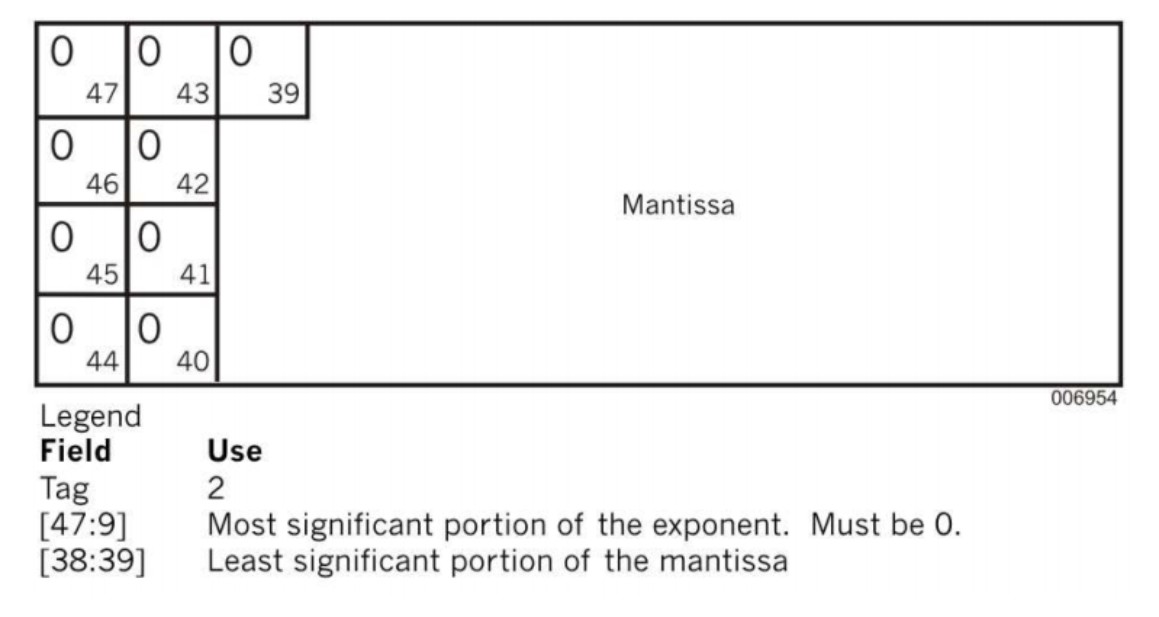
The internal structure of a dinteger operand is illustrated in First Word, Dinteger Operand and Second Word, Dinteger Operand.
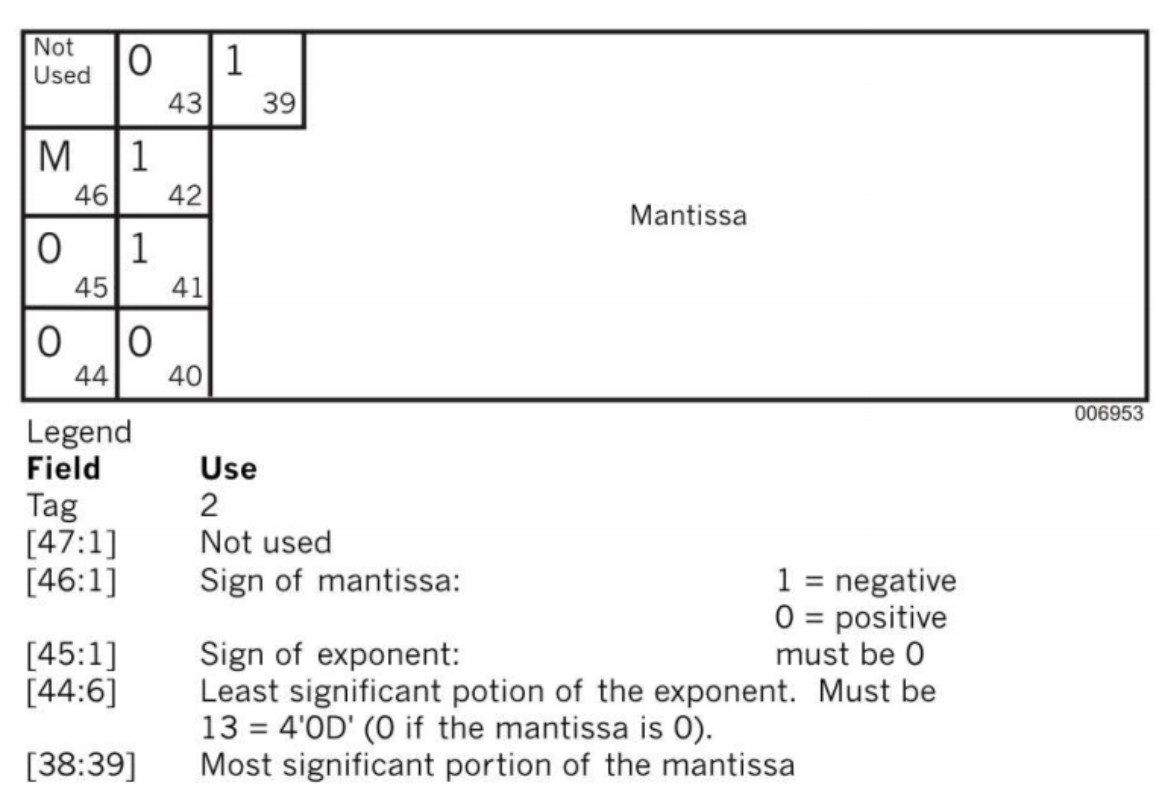
Double integer values are represented internally in signed-magnitude and mantissa-and-exponent notation. The sign of the mantissa is contained in 46 bit of the first data word. The sign of the exponent in 45 bit of the first data word must be 0 (zero).
The magnitude of the exponent of a double integer operand is contained in a total of 15 bits. The most significant 9 of these 15 bits are contained in field [47:9] of the second data word and must be 0 (zero). The least significant 6 of these 15 bits are contained in field [44:6] of the first data word and must be 13 (0 if the mantissa is 0).
The magnitude of the mantissa of a double integer operand is represented by a total of 78 bits. The most significant 39 bits are contained in field [38:39] of the first data word. The least significant 39 bits are contained in field [38:39] of the second data word.
The value represented by a double integer operand can be obtained by the following formula: MM * 8**13 + LM where
-
* MM is the most significant part of the mantissa
-
* LM is the least significant part of the mantissa
Double integer is a subset of the double-precision operand.
