
The internal structure of a real operand is illustrated in Real Operand.
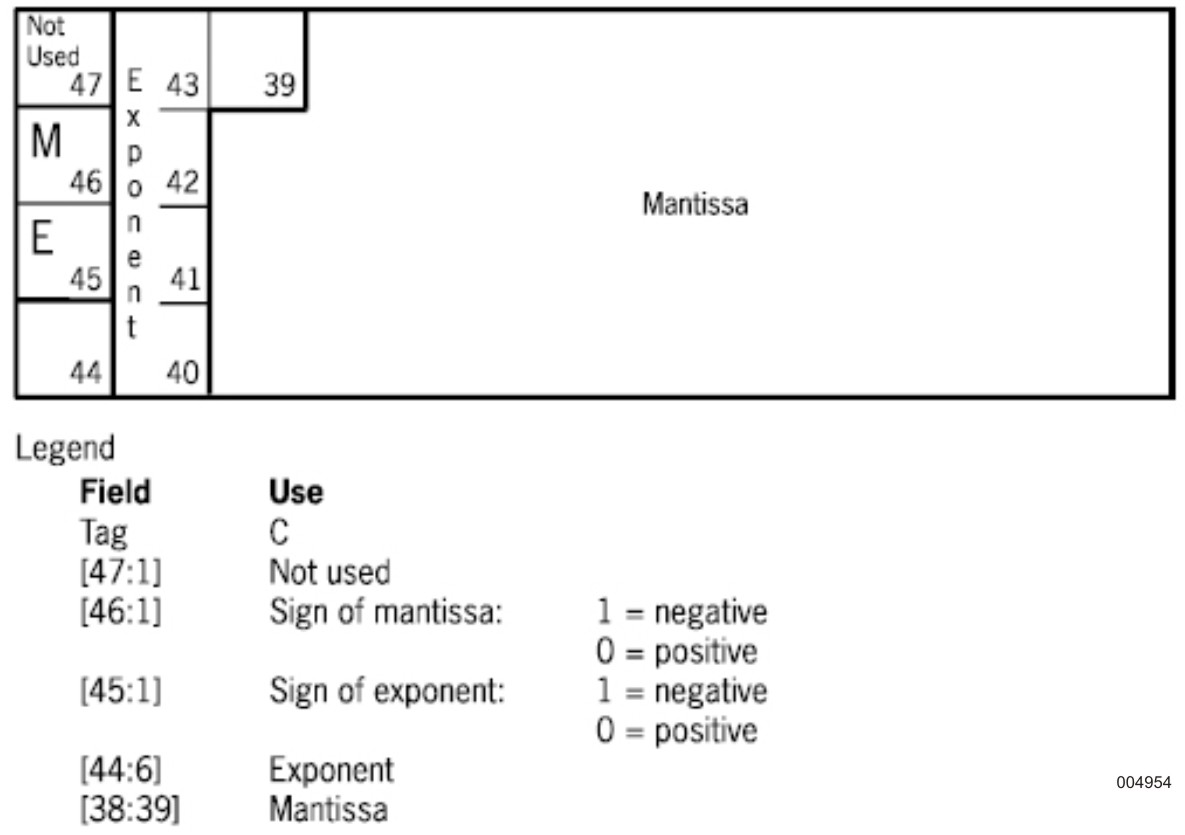
Real (single-precision, floating-point) values are represented internally in signed-magnitude, mantissa-and-exponent notation. The sign of the mantissa is contained in bit 46, and the sign of the exponent is contained in bit 45. A minus sign is denoted by a 1 in the appropriate sign bit. The magnitude of the exponent is contained in field [44:6]; hence, the maximum absolute value of an exponent in a real operand is 2**6–1 = 63. The magnitude of the mantissa is contained in field [38:39]; hence, the maximum absolute value of a mantissa in a real operand is 2**39–1. There is an implied radix point to the right of bit zero.
The value represented by a real operand can be obtained by the following formula:
(mantissa) * 8**(exponent)
Certain operations, such as the NORMALIZE function, return a normalized real operand as their result. A normalized real operand is a real operand in which the leftmost octade (3-bit field) of the mantissa is nonzero. For example, the real value 0.5, in normalized form, is represented internally as 4" 26C000000000". In this example, the mantissa is 4 * 8 ** 12 and the exponent is –13.
