
The internal structure of a double-precision operand is illustrated in First Word, Double-Precision Operand and Second Word, Double-Precision Operand.
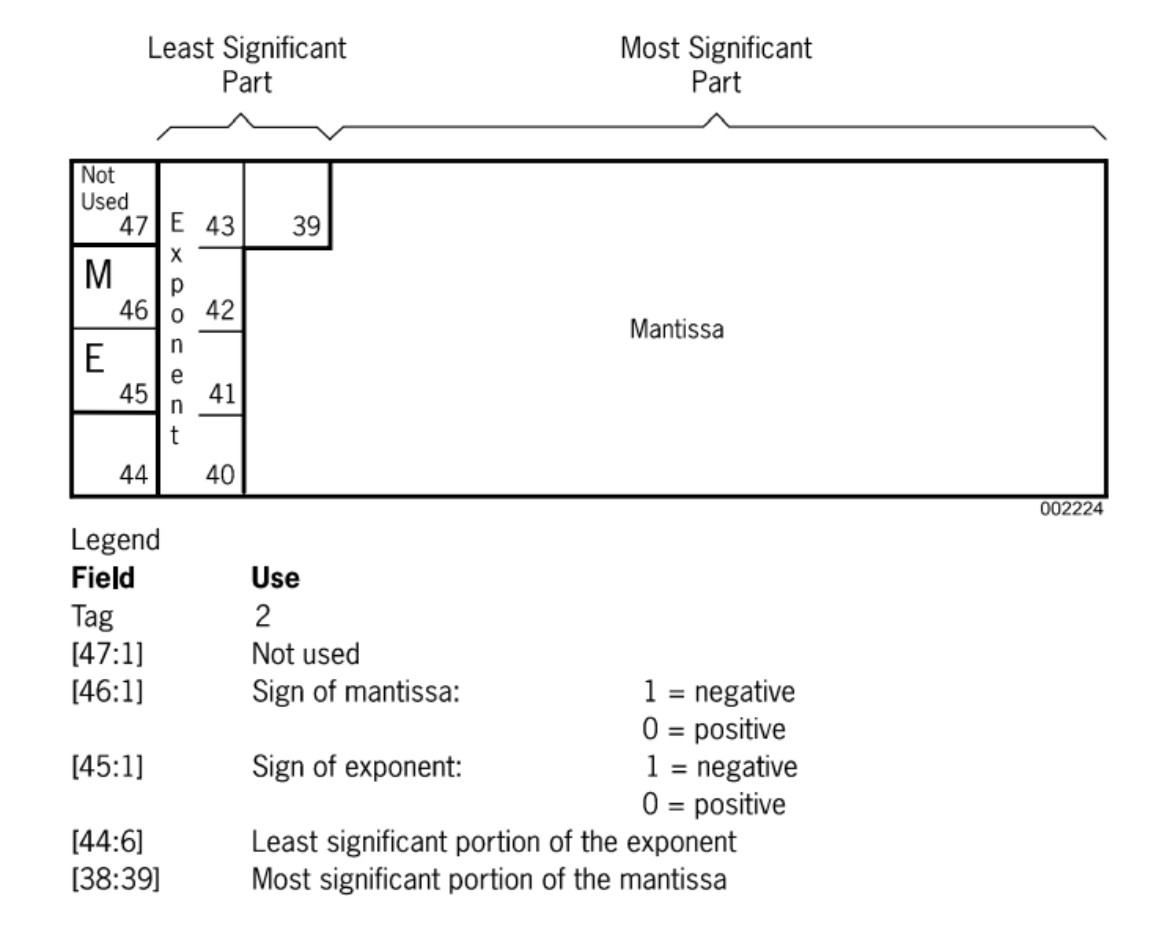
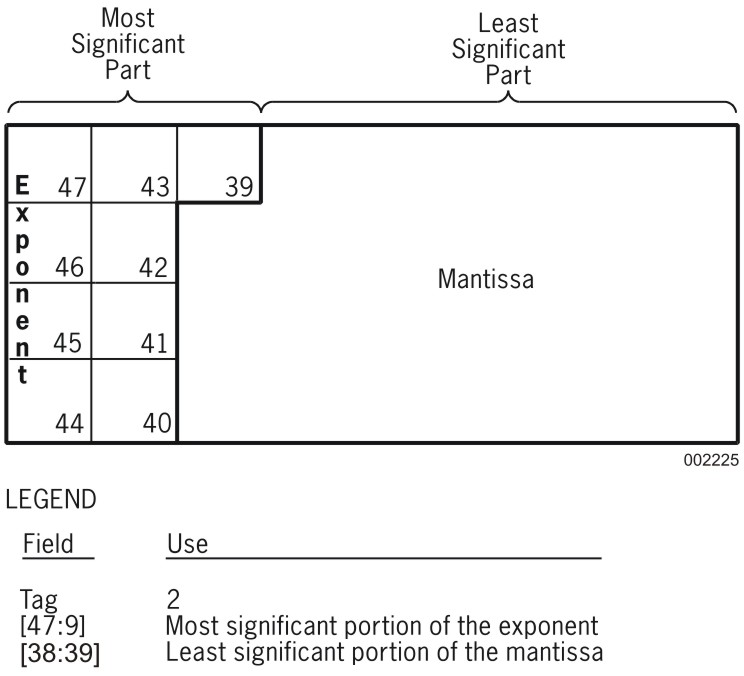
Double-precision values are represented internally in signed-magnitude, mantissa-and-exponent notation. The sign of the mantissa is contained in bit 46 of the first data word, and the sign of the exponent is contained in bit 45 of the first data word. A minus sign is denoted by a 1 in the appropriate sign bit.
The magnitude of the exponent of a double-precision operand is contained in a total of 15 bits. The most significant nine of these 15 bits are contained in field [47:9] of the second data word. The least significant six of these 15 bits are contained in field [44:6] of the first data word.
The magnitude of the mantissa of a double-precision operand is represented by a total of 78 bits. The most significant 39 bits are contained in field [38:39] of the first data word. The least significant 39 bits are contained in field [38:39] of the second data word. There is an implied radix point to the right of bit zero of the first data word; that is, between the most significant and least significant parts of the mantissa.
The value represented by a double-precision operand can be obtained by the following formula:
(MM + LM * 8**(-13)) * 8**(ME * 2**6 + LE)
where
-
MM is the most significant part of the mantissa.
-
LM is the least significant part of the mantissa.
-
ME is the most significant part of the exponent.
-
LE is the least significant part of the exponent.
Some operations return a normalized double-precision operand as their result. A normalized double-precision operand is a double-precision operand in which the leftmost octade (3-bit field) of the full 78-bit mantissa is nonzero. For example, the double-precision value 1@@0, in normalized form, is represented internally as
4"261000000000",74"000000000000"
In this example, the mantissa is 1 * 8*12 and the exponent is –12.
